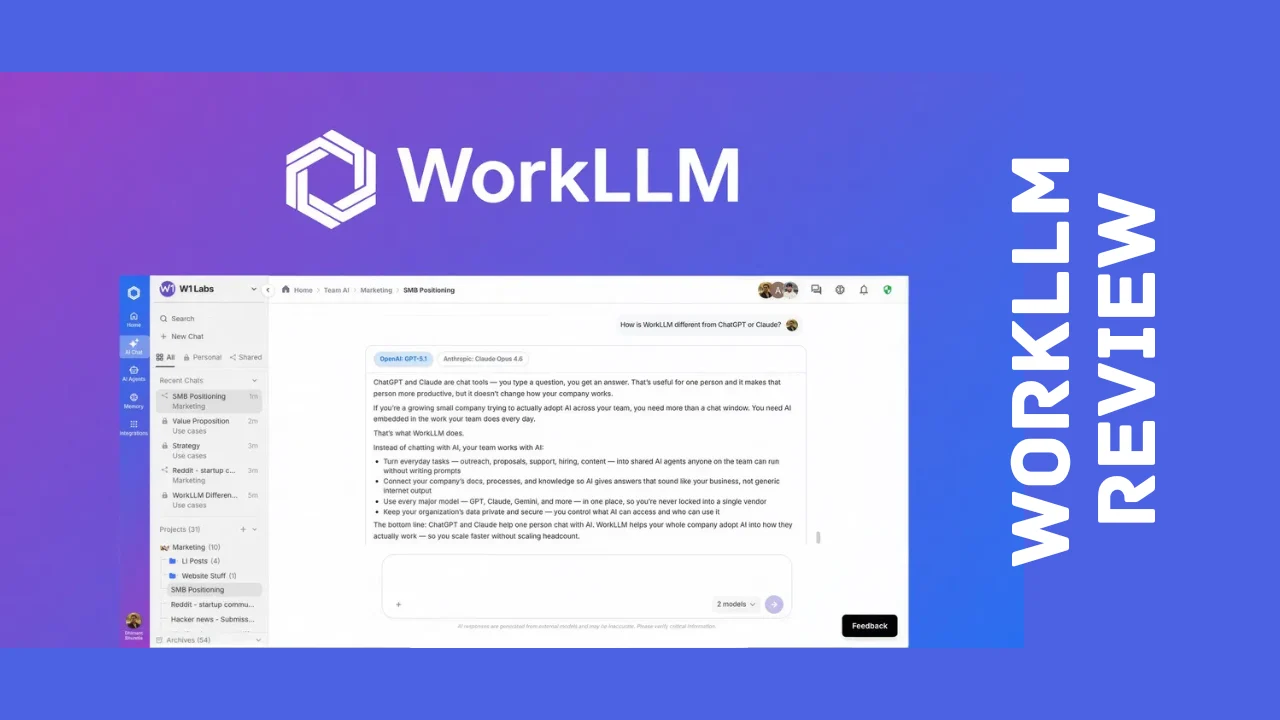
Most small businesses know they should be using AI more, but the reality is messier than the pitch decks make it sound. You end up juggling separate subscriptions for ChatGPT, Claude, and Gemini, nobody on the team knows which model is best for which task, and every new hire has to be re-briefed on company context from scratch. This WorkLLM review looks at a tool built to fix exactly that mess — a shared AI workspace that gives your whole team access to 200+ models, organization-wide memory, and ready-made AI agents, all without needing anyone to become a prompt engineer.
WorkLLM is built for marketers, remote teams, and small businesses that want to actually use AI for daily work, not just experiment with it in a browser tab nobody remembers to open. Instead of piecing together multiple AI subscriptions plus a separate collaboration tool, WorkLLM puts model access, team collaboration, and company memory into one workspace.
This review covers what WorkLLM actually does, how the pricing breaks down, what day-to-day use feels like, and how it compares to multi-model alternatives like Poe and single-vendor tools like ChatGPT Team.
Overview of WorkLLM
WorkLLM launched in February 2026 out of Toronto, built by co-founder and CEO Dhimant Bhundia after talking to a large number of small business owners who kept describing the same frustration. They knew AI could help them grow without adding headcount, but every time their team actually tried to use it, the experience became a part-time job of figuring out which tool to use, how to prompt it correctly, and how to keep context consistent across conversations.
The mission behind WorkLLM is to remove that barrier entirely. The idea is simple: if you can fill out a form or type a message, you should be able to use AI for real work, without needing to be technical or spend weeks learning prompt engineering. Rather than building yet another single-model chatbot, the team focused on three things working together: broad model access, a memory layer that remembers your company’s context, and purpose-built agents that handle specific tasks without requiring anyone to write a prompt at all.
The target audience is lean, resourceful small businesses and remote teams, specifically marketers and operators who need to punch above their weight without a budget to hire a specialist for every function AI could reasonably help with.
Key Features
WorkLLM’s feature set is built around removing friction at every stage, from picking a model to getting a team member up to speed on ongoing work. Here’s what stands out among WorkLLM’s features:
- Access to 200+ AI models, including GPT, Claude, Gemini, Llama, Mistral, and more, all from a single interface without separate subscriptions
- Side-by-side model comparison, letting you send the same prompt to up to four models at once to compare answers before acting on one
- Model filtering, so you can match the right model to a task based on type, cost, or strength instead of guessing
- Shared AI threads, where teammates can co-prompt together, comment and tag each other on AI responses, and share outputs without copy-pasting between tabs
- Organization-wide memory, storing company knowledge, past work, and key context so AI already understands your products, clients, and processes
- Project and folder memory, keeping AI grounded in the right context for each specific workflow rather than starting from zero every time
- Individual memory, personalizing responses based on how each team member works and what they typically need
- Thread memory, automatically capturing ongoing conversation context so anyone can pick up a project mid-stream without re-explaining the background
- Purpose-built AI agents (available on Tier 2 and above), ready to use out of the box for sales, marketing, HR, and other common workflows without any prompting required
- Custom agents, grounded in your own policies, documents, and organization memory for tasks your team handles repeatedly
- Role-based access control and audit logs, letting you control who can run, build, and access agents, with a full activity trail
- Web search, deep research, and document, image, audio, and video chat, extending the AI chat beyond plain text conversations
That combination of broad model access, persistent memory, and ready-made agents is a genuinely different approach than a single-model chatbot subscription, and it’s clearly aimed at teams who want AI embedded in daily workflows rather than treated as a novelty tool.
Ease of Use & User Experience
WorkLLM is built specifically to avoid the “figuring out where to start” problem that keeps a lot of small teams from actually adopting AI. The core promise is that if you can fill out a form or send a message, you can use the platform, and the agent-based workflows back that up: instead of writing a prompt from scratch, you pick an agent built for the task you’re trying to do, like hiring, prospecting, or content creation, and it runs with no prompting required.
The shared thread structure means collaboration happens inside the AI conversation itself rather than through screenshots pasted into Slack. Being able to comment and tag teammates directly on an AI response, then have that context saved to organization memory with one click, is a genuinely practical touch for teams that want good AI outputs to compound over time instead of getting lost in individual chat histories.
Because WorkLLM only launched in February 2026, it’s still a young platform without years of interface refinement behind it, so expect some rough edges as the product matures, particularly around more advanced agent customization. For day-to-day AI chat, model comparison, and basic agent use, the barrier to entry is low enough that non-technical team members should be productive quickly. The platform runs as a web-based workspace, so it’s accessible from desktop and mobile browsers without a dedicated app to install.
WorkLLM Pricing Breakdown
WorkLLM is available as a one-time payment for lifetime access instead of the recurring monthly subscription you’d pay for stacking separate AI tools together. That structure is a major part of what makes this WorkLLM review worth reading if you’re currently paying for multiple individual AI subscriptions across your team, since a single upfront payment can replace what would otherwise be an ongoing per-seat bill.
Every tier includes AI chat, multi-LLM access, team collaboration features, web search and deep research, document and media chat, organization memory, role-based access control, audit logs, data encryption, and usage reporting. What changes between tiers is your monthly AI credit allowance, the number of users included, and access to purpose-built AI agents.
| What’s Included | Tier 1 | Tier 2 | Tier 3 (Most Popular) | Tier 4 |
|---|---|---|---|---|
| Price | $79 (regular $240) | $179 (regular $1,800) | $299 (regular $5,400) | $589 (regular $10,000) |
| Access | Lifetime access | Lifetime access | Lifetime access | Lifetime access |
| AI credits | 800/month | 2,000/month | 4,000/month | 8,000/month |
| Users | 1 | 5 | 15 | Unlimited |
| AI agents | Not included | Included | Included | Included |
| Organization memory | Included | Included | Included | Included |
| Role-based access control | Included | Included | Included | Included |
| Refund window | 60 days | 60 days | 60 days | 60 days |
Every tier is backed by a 60-day refund window, giving you real time to test the workspace against your team’s actual daily tasks before deciding whether to keep it. There isn’t a separate free trial beyond that guarantee, but since it’s a one-time purchase, the refund period functions as a full trial run without a subscription clock running in the background.
Worth noting specifically: purpose-built AI agents, one of WorkLLM’s more distinctive features, are only available starting at Tier 2, so a solo operator on Tier 1 gets full multi-model chat and organization memory but not the ready-made agents. For a single founder or freelancer, Tier 1 covers core AI chat needs, but any small team that wants the no-prompting-required agent workflows should budget for Tier 2 or higher. Compared to paying for individual AI subscriptions across a five or fifteen-person team every month, WorkLLM pricing as a one-time payment stands out as one of the more affordable software options for small businesses trying to standardize AI use without a growing monthly bill.
Pros and Cons
| Pros | Cons |
|---|---|
| One-time lifetime payment instead of stacking multiple AI subscriptions | AI agents are locked behind Tier 2 and above |
| Access to 200+ models from one interface, no separate accounts needed | Very new platform with a small, still-growing review base |
| Organization memory keeps AI grounded in real company context | Monthly AI credit allowance can run low with heavy multi-model use |
| Shared threads make team collaboration on AI outputs genuinely practical | Tier 1 is limited to a single user |
| Side-by-side model comparison removes guesswork on which model to use | Some advanced agent customization is still maturing |
| Role-based access control and audit logs support real team governance | Smaller founding team means slower support response than larger vendors |
| 60-day refund window on every tier | Web-only, no dedicated mobile app yet |
Who Should Use It?
WorkLLM is a strong fit if you recognize your situation in any of these groups:
- Small business owners and solopreneurs who want to use AI across outreach, research, hiring, and content without hiring for every function separately
- Marketers who need to compare model outputs quickly and keep AI grounded in brand voice and past campaign context
- Remote teams that want to collaborate on AI conversations directly instead of pasting screenshots between tools
- Founders and operators juggling multiple individual AI subscriptions who want to consolidate into one workspace with shared memory
- Growing teams that need role-based access control and audit logs as more people start relying on AI for daily work
It’s less of a fit if you’re a solo user who only ever needs one model and has no interest in team collaboration features, where a single AI subscription might be simpler. But for lean teams trying to actually operationalize AI across daily tasks rather than experimenting with it occasionally, WorkLLM stands out as one of the more genuinely useful productivity tools for entrepreneurs who need to do more without adding headcount.
Comparison With Competitors
| Feature | WorkLLM | Poe | ChatGPT Team |
|---|---|---|---|
| Pricing model | One-time lifetime payment | Monthly subscription (~$5–$20/mo) | Monthly per-seat subscription (~$25–$30/user/mo) |
| Multi-model access | 200+ models | 100+ models | OpenAI models only |
| Organization-wide memory | Yes | No | Limited |
| Ready-made AI agents | Yes (Tier 2+) | No | Limited (custom GPTs) |
| Shared team threads and collaboration | Yes | Limited (group chat) | Limited |
| Role-based access control and audit logs | Yes | No | Yes |
| Best for | Small teams standardizing AI across daily work | Individuals comparing models casually | Teams committed to OpenAI’s ecosystem |
Poe is a strong option if you mainly want casual access to multiple models without any team infrastructure around it, but it lacks organization memory, ready-made agents, and the kind of role-based governance a growing team eventually needs. ChatGPT Team offers solid collaboration and admin controls, but it locks you into OpenAI’s models specifically and charges a recurring per-seat fee that adds up fast as headcount grows. If you’re weighing WorkLLM alternatives, the honest takeaway is that Poe wins for casual, individual model comparison, ChatGPT Team wins if your team is fully committed to OpenAI’s ecosystem, and WorkLLM’s advantage is combining broad multi-model access with real team memory and governance at a one-time price.
User Feedback Summary
Because WorkLLM only launched in February 2026, it doesn’t yet have the review volume you’d find for an established AI workspace across major software review platforms, and independent reviews on sites like G2, Capterra, or Trustpilot remain limited at this early stage. That’s worth stating plainly rather than treating a handful of early reviews as a definitive verdict.
Early sentiment has been notably positive, with an overall rating solidly in the mid-4s out of 5 from the reviews available so far. Feedback has centered on the practical value of having 200+ models accessible without managing separate subscriptions, along with genuine appreciation for organization memory reducing the need to re-explain company context in every new conversation.
As with any brand-new platform, the realistic read is that early impressions are encouraging, but buyers should treat WorkLLM as an early-adopter opportunity on a promising product rather than a workspace with years of proven public reviews behind it.
Frequently Asked Questions
What is WorkLLM used for?
WorkLLM is a shared AI workspace that gives teams access to 200+ AI models, organization-wide memory, and ready-made AI agents for tasks like outreach, research, hiring, and content creation. It’s designed to let non-technical teams use AI for daily work without needing prompt engineering skills.
Is WorkLLM a one-time payment or a subscription?
WorkLLM is currently sold as a one-time lifetime payment across four pricing tiers, rather than a recurring monthly subscription. Each tier includes a set number of monthly AI credits and users, with purpose-built AI agents available starting at Tier 2, backed by a 60-day refund window.
How is WorkLLM different from ChatGPT or Poe?
ChatGPT Team locks you into OpenAI’s models with a recurring per-seat subscription, and Poe offers broad model access but lacks organization memory and team governance features. WorkLLM combines access to 200+ models with organization-wide memory, ready-made agents, and role-based access control, all for a one-time payment.
Does WorkLLM require technical skills to use?
No, WorkLLM is built specifically for non-technical teams. Purpose-built AI agents handle common tasks like hiring, prospecting, and content creation without requiring anyone to write a prompt, and the shared chat interface works similarly to a messaging app.
What is organization memory in WorkLLM?
Organization memory is WorkLLM’s system for storing company knowledge, past work, and key context so AI already understands your products, clients, and processes before a conversation starts. It also includes project, individual, and thread-level memory to keep AI grounded in the right context for each specific workflow.
Is WorkLLM good for small businesses and remote teams?
WorkLLM is built specifically for lean, resourceful small businesses and remote teams that want to punch above their weight without hiring for every function AI could help with. Combined with its one-time payment model, it’s one of the more affordable software options for teams that would otherwise pay for multiple individual AI subscriptions.
How many AI models does WorkLLM support?
WorkLLM provides access to more than 200 AI models, including GPT, Claude, Gemini, Llama, Mistral, and others, all from a single interface. Users can also send the same prompt to up to four models simultaneously to compare responses before deciding which one to use.
Does WorkLLM offer a refund if it doesn’t work for my team?
Yes, every WorkLLM pricing tier includes a 60-day refund window, giving you enough time to test the workspace against your team’s real daily tasks and evaluate whether the multi-model access and organization memory genuinely fit your workflow before deciding to keep it.
Final Verdict
Wrapping up this WorkLLM review, the platform earns a solid recommendation for small businesses and remote teams that want to actually operationalize AI across daily work instead of experimenting with it occasionally. The combination of broad model access, organization-wide memory, and ready-made agents addresses a real problem: AI tools that work well individually but don’t scale cleanly across a team without a lot of manual re-explaining.
It’s not without trade-offs. As a brand-new platform, it hasn’t built up years of public reviews yet, and the more distinctive agent features require stepping up to Tier 2 or higher. But for lean teams trying to consolidate multiple AI subscriptions into one workspace with real memory and governance, WorkLLM delivers genuine value at a one-time price, and it’s well worth testing against your team’s actual daily workflows before committing to a pricier, subscription-based alternative.